Friday, July 26, 2013

40 Bishop

Bishop Michael Campbell
carrying his crozier
A Bishop is responsible for looking after the Church in an area called a diocese. He is a pastoral leader and he serves the people in his diocese. He carries out visitations of the parishes in his diocese so that he can get to know the needs of the people and offer guidance and support to the priests. To read more about the Bishop's parish visitations read his blog. He celebrates Mass with the parishes he visits and he guides the people in following the way of Jesus. The Bishop also celebrates the Sacrament of Confirmation and he ordains men to the priesthood. A Bishop wears a special tall hat called a mitre and he carries a staff, also known as a crozier. His crozier is a reminder that the Bishop is carrying out the role of a shepherd in guiding and protecting his people and he is continuing the work of Jesus who called himself 'the good shepherd'.
Bishop Patrick O'Donoghue
handing over the crozier

When Bishop Michael sat on the Cathedra (Bishop's chair) and assumed responsibility as Bishop of Lancaster, his predecessor Bishop Patrick O'Donoghue said:
"Bishop Michael, at the wish of the Holy Father Pope Benedict XVI you now assume from me the pastoral charge of the Diocese of Lancaster.  With confidence and trust I hand this crozier as a sign of the shepherd's office.  May the Lord sustain you in this office which is entrusted to you by the Holy Spirit for the service of the church of God.  Dear people of God, I present to you your Bishop". 

Details of the Bishop's ordination rite were reported in detail at the time, to learn more about the different parts of the service see the original Lancaster Cathedral Blog 

Monday, July 22, 2013

Year of Faith Catechists

Extract from Bishop's Blog 20th July 2013
A big thank you and congratulations to our Year of Faith Catechists

Extract from Bishop's Blog 20th July 2013
Mention of St. Peter’s Cathedral, it is pleasing to record that well over sixty Year Six classes from our Diocesan Catholic Primary Schools have over the past Year of Faith spent a day ‘on pilgrimage’ to the cathedral. The theme of ‘sacramental journey’ figured prominently on these days, and by all accounts the children and teachers were enthralled by their experience of the mother church of the Diocese. The cathedral staff and the many volunteers are to be warmly congratulated in giving so generously of their time and knowledge to our teachers and children. Many thanks indeed to all concerned!

And for the next month an opportunity to visit the Lives and Times of the English Martyrs exhibition 'My Faith is my Crime'.

Thursday, July 18, 2013

39 Miraculous Medal

Miraculous Medal
Many Catholics throughout the world wear the miraculous medal. On the front side of the medal, Mary is standing on a globe, crushing the head of a serpent under her foot. This symbolises Mary as Queen of Heaven and Earth who has power over Satan and evil, as shown by the serpent. On the other side of the medal is the letter 'M' linked into the cross. The 'M' stands for Mary and the cross shows Mary's closeness to Jesus and his sufferings. There are twelve stars around the medal which may symbolise the Apostles who represent the entire Church or they can also recall a vision of St John, writer of the Book of Revelation (12:1) in which 
'a great sign appeared in heaven, a woman clothed with the sun, and the moon under her feet, and on her head a crown of twelve stars.' 
St Catherine Laboure
Catholics wear the miraculous medal as a sign of their devotion to Mary, the Mother of Jesus. The medal started when Mary appeared to St Catherine Laboure who was a nun from the order of the Daughters of Charity in Paris in 1830. Mary told Catherine that she had a mission for her. During a vision, Catherine was told that if people wear the medal that Mary showed her, they would receive many blessings. Catholics continue to wear the medal today as a sign of their love and devotion to Mary and all that we can learn from her example about how to follow Jesus.

O Mary who was conceived without sin have mercy on us who as recourse to thee


A colouring and little booklet for children about the Miraculous Medal and Saint Catherine Laboure 
CCC 722 The Holy Spirit prepared Mary by his grace. It was fitting that the mother of him in whom "the whole fullness of deity dwells bodily" should herself be "full of grace." She was, by sheer grace, conceived without sin as the most humble of creatures, the most capable of welcoming the inexpressible gift of the Almighty. It was quite correct for the angel Gabriel to greet her as the "Daughter of Zion": "Rejoice." It is the thanksgiving of the whole People of God, and thus of the Church, which Mary in her canticle lifts up to the Father in the Holy Spirit while carrying within her the eternal Son.


This short video (2.53) outlines the life of St Catherine Laboure and invites us to consider what we may be being called to do.

Tuesday, July 16, 2013

38 - Scapular ... other scapular

A scapular is a sacramental.  The Catechism of the Catholic Church explains how:
CCC 1670 Sacramentals do not confer the grace of the Holy Spirit in the way that the sacraments do, but by the Church's prayer, they prepare us to receive grace and dispose us to cooperate with it. "For well-disposed members of the faithful, the liturgy of the sacraments and sacramentals sanctifies almost every event of their lives with the divine grace which flows from the Paschal mystery of the Passion, Death, and Resurrection of Christ. From this source all sacraments and sacramentals draw their power. There is scarcely any proper use of material things which cannot be thus directed toward the sanctification of men and the praise of God."1

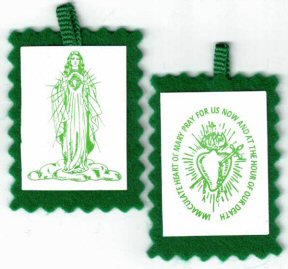
Green Scapular
"Immaculate Heart of Mary, pray for us now and at the hour of our death."
For further information about the green scapular click here

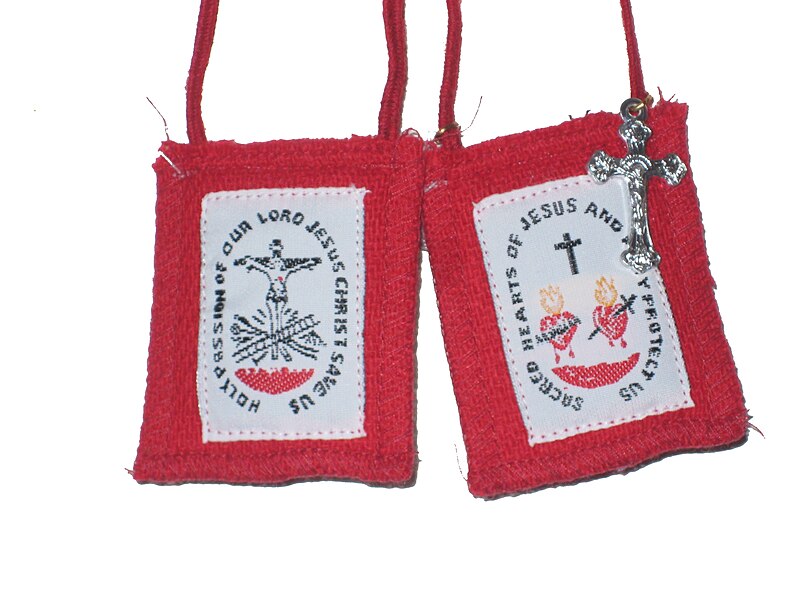
Red Scapular

"Holy Passion of Our Lord Jesus Christ Save us"; 
the other side shows the Sacred Heart of Jesus and the Immaculate Heart of Mary, "Sacred Hearts of Jesus and Mary, protect us."


For further information about other scapulars

Saturday, July 13, 2013

38 Brown Scapular

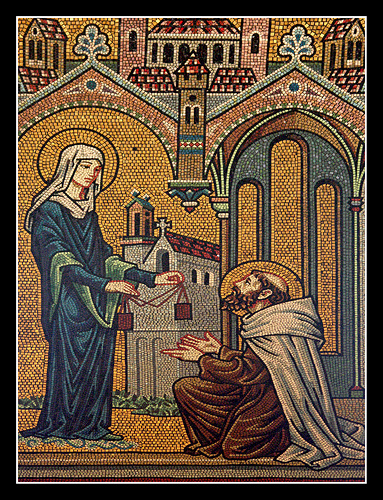
St Simon Stock receiving
the brown scapular
'Our Lady of Mount Carmel' is a name used for Mary and the feast of Our Lady of Mount Carmel is celebrated on 16th July. Our Lady of Mount Carmel is the patroness of the Carmelite religious order which was first started by a group of Christian hermits who lived on Mount Carmel in the Holy Land. Today the Carmelite order includes Carmelite Friars who serve God by guiding people in their prayer and faith life, Carmelite nuns who live enclosed lives and serve God in prayer and Carmelite laypeople who are committed to serving God in the spirit of the Carmelites in their everyday life – Carmelite laypeople may be married. Carmelites wear a brown scapular. Many years ago, this was a long brown garment that covered them from shoulder to feet. It became a symbol of their dedication to Mary. Over time, the brown scapular changed to become two pieces of brown cloth joined by a string. One cloth hangs on a person's chest and the other hangs on their back. It is worn under a person's clothes and it is a sign of their commitment to following Jesus as Mary did. Mary shows us: how to be open to God and his will; how to be guided by faith, hope and love; how to be close to the needs of others; how to pray at all times; and how to discover God as present in all that happens around us.

An article about the brown scapular and detail  link  

Saturday, July 6, 2013

My Life is My Crime: Lives & Times of English Martyrs

Cope with symbols of martyrs 
19th July to 7th August
A month long exhibition and programme of liturgy and devotions, talks and films remembering the lives of the the English Martyrs.  This exhibition is part of Lancaster Cathedral's Year of Faith celebrations and gives us an opportunity to give thanks to those who have died for their faith.  There will be a full programme of events on the feast days of the 
Lancashire Martyrs - 19th July
Cumbrian Martyrs - 24th July
Lancaster Martyrs - 7th August
Films will be shown at 2.00pm in St Walburge's Chapel, Balmoral Road, Lancaster.  They last between 30 minutes and 1 hour.  
Talks take place on 19th, 24th and 30th July and 7th August.  
Cloister CafĂ© will serve lunch between 1 - 2 pm
For details of what is happening on individual days see Lancaster Cathedral calendar or a poster of the full programme. 


Tuesday, July 2, 2013

37 Pope

There have been more than 200 popes since then. As Catholics, we believe that they share in the authority that Peter was given and the Holy Spirit helps them to discern the true faith which they share with the Church and with the world.  At the start of our year of faith there were five Popes since Vatican II - see below and spot the mistake in the titles!

However, following his surprise resignation this year the current Pope is Pope Francis who was elected earlier this year. All the popes are shown on the year of faith timeline which is on view in Lancaster Cathedral together with a range of fascinating facts.  
A member of the Holy Communion programme
pointing out our new Pope Francis.