Saturday, October 26, 2013

54 Statue of Our Lady

Statute of Mary the Mother of God
A statue of Our Lady is found in all Catholic Churches and this is because of the special devotion with which the Church honours Mary. From ancient times, Mary has been called 'Mother of God' and she is the perfect role model for us all. She said 'yes' to God and gave her life completely to carrying out God's will. Mary knew joy and she also knew suffering. 
We call her Mother of the Church and our Mother and we can turn to her with our own joys and sorrows. We can pray with Mary and we can pray to her. We ask her to intercede for us which means that we ask her to ask Jesus for our desires, believing that Jesus listens to his Mother who prays for us.


CCC 971 "All generations will call me blessed": "The Church's devotion to the Blessed Virgin is intrinsic to Christian worship." The Church rightly honours "the Blessed Virgin with special devotion. From the most ancient times the Blessed Virgin has been honoured with the title of 'Mother of God,' to whose protection the faithful fly in all their dangers and needs. . . . This very special devotion . . . differs essentially from the adoration which is given to the incarnate Word and equally to the Father and the Holy Spirit, and greatly fosters this adoration." The liturgical feasts dedicated to the Mother of God and Marian prayer, such as the rosary, an "epitome of the whole Gospel," express this devotion to the Virgin Mary.
Mother and child -
entry in original Cathedral Blog
We welcome photographs of statues of Mary or drawings - please get in touch using the contact page.

Saturday, October 19, 2013

53 Memorare

The Memorare is a prayer that reminds us that Mary is our protector and one to whom we can ask for help. It is thought that St Bernard of Clairvaux may have written the prayer in the 12th century. In the 17th century, a priest called Father Claude Bernard used the prayer often in his work with the sick and those in prison and he believed that Mary truly helped him in his work. The Church teaches that Mary is the Mother of the Church and our mother as well “in the order of grace” (which means spiritually) as we read in the Catechism of the Catholic Church (CCC 969).

Remember, O most gracious Virgin Mary,
that never was it known that anyone who fled to thy protection,
implored thy help, or sought thy intercession was left unaided.
Inspired with this confidence,
I fly to thee, O Virgin of virgins, my Mother;
to thee do I come;
before thee I stand, sinful and sorrowful.
O Mother of the Word Incarnate,
despise not my petitions,
but in thy mercy hear and answer me. Amen
Link to he above video which is a modern musical version of the Memorare  
CCC 2675 Beginning with Mary's unique cooperation with the working of the Holy Spirit, the Churches developed their prayer to the holy Mother of God, centering it on the person of Christ manifested in his mysteries. In countless hymns and antiphons expressing this prayer, two movements usually alternate with one another: the first "magnifies" the Lord for the "great things" he did for his lowly servant and through her for all human beings the second entrusts the supplications and praises of the children of God to the Mother of Jesus, because she now knows the humanity which, in her, the Son of God espoused.
For further information about St Bernard of Clairvaux 


St Bernard of Clairvaux 1090-1153

Tuesday, October 15, 2013

52 Rosary Mary shows the way

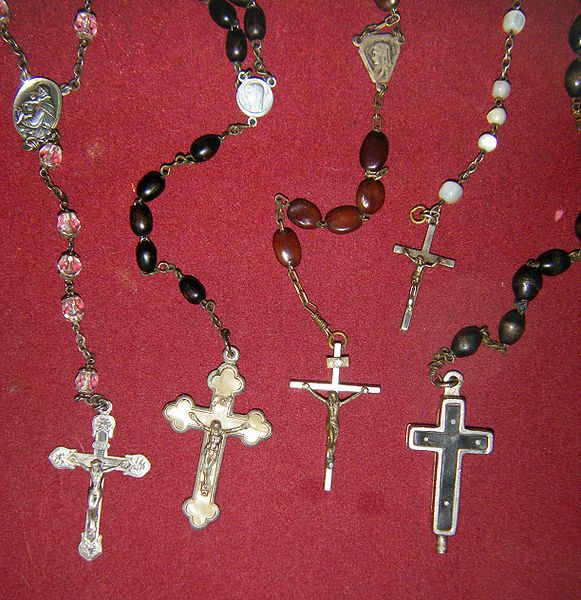
Assorted Rosary Beads
CCC 2674 Mary gave her consent in faith at the Annunciation and maintained it without hesitation at the foot of the Cross. Ever since, her motherhood has extended to the brothers and sisters of her Son "who still journey on earth surrounded by dangers and difficulties." Jesus, the only mediator, is the way of our prayer; Mary, his mother and ours, is wholly transparent to him: she "shows the way" (hodigitria), and is herself "the Sign" of the way, according to the traditional iconography of East and West.
Praying the Rosary on line
This is a site where you can join others in praying the rosary


Is the rosary said at your Church?  This is a form of prayer that can be said alone or in small groups.  Some parishes have a set time in the week, many pray the rosary on the first Saturday.  For details of the first Saturday rosary at the Cathedral in Lancaster and the Lancaster Cathedral Diary.   

Friday, October 11, 2013

52 Rosary

Three of the Mysteries - Joyful, Sorrowful and Glorious
October is the month of the Rosary. The Rosary is a way of praying that honours Mary and asks for her help or intercession. Special beads, known as 'Rosary beads' are used and these help us to count the series of prayers that make up the Rosary. The Rosary is split into four groups called
The Joyful Mysteries,
The Mysteries of Light, or Luminous Mysteries
The Sorrowful Mysteries and
The Glorious Mysteries. 


These in turn are each divided into five times in the life of Jesus and Mary that we reflect on when we pray the Rosary. 


 Joyful Mysteries are:
The Annunciation
The Visitation
The Nativity
The Presentation of Jesus in the Temple
The Finding of the Child Jesus in the Temple

Each time we reflect on one of these times, we pray a decade of the Rosary. 
A decade means a group of ten prayers and it starts with one 'Our Father', then ten 'Hail Marys' and ends with a 'Glory be to the Father'. The Rosary beads help us to count the ten Hail Marys so that as our fingers touch the beads and we pray the words we can imagine the scene we are reflecting on and open our hearts to Jesus.

Luminous Mysteries are:

The Baptism in the Jordan (Top left)

The Wedding at Cana (Marriage at Cana) (Top right)

The Proclamation of the Kingdom of God (Christian mission) (Bottom Left)
The Transfiguration (Bottom right)
The Institution of the Eucharist (Last Supper) (Centre)

Prayer Card of Luminous Mysteries
For further prayer cards see The Way of Beauty Blog


Tuesday, October 8, 2013

51 Religious Sisters in Lancaster Diocese


During the Vocations Novena in 2013 there were a number of posts in the Cathedral and St Thomas More parish blog.  If you would like to know more about the following 


Ursuline Sisters - who are based at St Thomas More.  To read more see also Sr Zela Proctors own blog. 
Ursuline-religious life Blog
Our Lady of Hyning  - and to read more of the Gospel and Grub prayer group being led by Sr Maria from Hyning.   
Advert for Gospel and Grub Prayer Group
For further details 
Sisters of Nazareth - one of the earliest religious groups in Lancaster, to read more about the early days of the Sisters of Nazareth.


For further information about vocations and discernment days or weekends organised by religious sisters in the Diocese see their websites links available in the posts mentioned above and the Diocesan Vocations website.  


Poster Please pray for priests and religious

Friday, October 4, 2013

51 Religious Life

Screen capture of UK Religious Life list of religious orders 
Religious life is an invitation to live life to its fullest with total commitment to God, as a member of a religious community. A person who is called to religious life becomes a nun (female) or a monk (male). They take three vows: poverty, obedience and celibacy. This means that they live simply, they are obedient to the rule of their order and the will of God and they do not marry. In this way, they are free to give themselves completely in service of the Church and to do this wherever they are called to be. For some, this may mean travelling to other parts of the world to serve and share the Gospel with those in need. For others, it may be serving in parishes, hospitals, schools and communities in this country. Some religious sisters (nuns) and brothers (monks) enter enclosed orders which means they spend most of their time just with their religious community and they serve the Church in prayer.

Screenshot from UK Religious Life website

CCC 931 Already dedicated to him through Baptism, the person who surrenders himself to the God he loves above all else thereby consecrates himself more intimately to God's service and to the good of the Church. By this state of life consecrated to God, the Church manifests Christ and shows us how the Holy Spirit acts so wonderfully in her. And so the first mission of those who profess the evangelical counsels is to live out their consecration. Moreover, "since members of institutes of consecrated life dedicate themselves through their consecration to the service of the Church they are obliged in a special manner to engage in missionary work, in accord with the character of the institute."


During the novena for vocations the Cathedral Parish blog had a number of posts about religious sisters who have had a connection with the Lancaster Diocese and the Cathedral and St Thomas More's parish in particular.  In the next few days we'll include some links to religious sisters in the Lancaster Diocese.