Tuesday, October 30, 2012

3 Bible - Old and New Testament


The Bible is one story made up on many books. It tells the story of God's relationship with his people, his love for them and their response to his love. It was written over hundreds of years by many different writers and can be divided into the Old Testament and New Testament. 
The first forty-six books of the Bible are called the Old Testament and they record the history of God's people, the Israelites. 
The New Testament is made up of the books about Jesus and the early Church. The Gospels tell us about the life and teachings of Jesus. Some of the others books and letters tell us about Jesus' followers, the early Christians and how the Church began.
CCC 120 It was by the apostolic Tradition that the Church discerned which writings are to be included in the list of the sacred books. This complete list is called the canon of Scripture. It includes 46 books for the Old Testament (45 if we count Jeremiah and Lamentations as one) and 27 for the New.
The Old Testament: 
Genesis, Exodus, Leviticus, Numbers, Deuteronomy, Joshua, Judges, Ruth, 1 and 2 Samuel, 1 and 2 Kings, 1 and 2 Chronicles, Ezra and Nehemiah, Tobit, Judith, Esther, 1 and 2 Maccabees, Job, Psalms, Proverbs, Ecclesiastes, the Song of Songs, the Wisdom of Solomon, Sirach (Ecclesiasticus), Isaiah, Jeremiah, Lamentations, Baruch, Ezekiel, Daniel, Hosea, Joel, Amos, Obadiah, Jonah, Micah, Nahum, Habakkuk, Zephaniah, Haggai, Zachariah and Malachi.
The New Testament: 
The Gospels according to Matthew, Mark, Luke and John, the Acts of the Apostles, the Letters of St. Paul to the Romans, 1 and 2 Corinthians, Galatians, Ephesians, Philippians, Colossians, 1 and 2 Thessalonians, 1 and 2 Timothy, Titus, Philemon, the Letter to the Hebrews, the Letters of James, 1 and 2 Peter, 1, 2 and 3 John, and Jude, and Revelation (the Apocalypse).


Remember that during this coming week which is Half Term the Cathedral Parish Blog will have videos, colouring and songs linked to the Bible - related activities.

Sunday, October 28, 2012

3 Bible - Liturgy of the Word

Cathedral Parish Newsletter 30th Sunday Year B
with details of readings
The object of faith this week is the Bible.  We listen to the Bible every time we come to Mass.  The Church organises the Sunday readings over a three year cycle.   

In the Vatican II Constitution of the Sacred Liturgy Sacrosanctum Concilium (SC) it explains how:  


SC 51. The treasures of the bible are to be opened up more lavishly, so that richer fare may be provided for the faithful at the table of God's word. In this way a more representative portion of the holy scriptures will be read to the people in the course of a prescribed number of years.
How to find out what the readings are?
The Liturgy Office provides a list of the readings for each of the years.  For a link to 31st Sunday Ordinary Time Year B click here
The Cathedral parish newsletter includes a list of the readings and responses.  Check your newsletter for details.


Commentaries on the readings: Wednesday Word and Living Space
For a commentary on the Sunday reading that is available on the Wednesday before the Sunday click Wednesday Word


For commentaries on Sunday and weekday Masses click Living Space 


During this coming week which is Half Term the Cathedral Parish Blog will have videos, colouring and songs linked to the Bible - related activities.

Friday, October 26, 2012

2 Vatican II Documents: Declarations and Decrees

Diagram of the Vatican II documents
Constitutions, Declarations and Decrees
The core documents from Vatican II were the four Constitutions.  In addition there were four Declarations and 12 Decrees.  The different types of document help to show the level of authority and the amount time and level of agreement on the topics.  The diagram above organises the Vatican II documents into three broad areas. The links below provide a useful index to these Vatican II documents. 

Mission
Decree Ad Gentes on the mission activity of the church
Decree on priestly training Optatam Totius on 28th October 1965
Declaration on Education Gravissimum Educationis  28th October 1965 
Decree on the media of social communications Inter Mirifica  on 4.12.1963

People of God
Decree on the pastoral office of bishops in the church Christus Dominus  on 28.10.1965
Decree on the adaptation and renewal of religious life Perfectae Caritatis on 28.10.1965
Decree on the Apostolate of the Laity Apostolicam Actuositatem on 18.11.1965
Decree on the ministry and life of priests Presbyterorum Ordinis on 7.12.1965

External Relations
Decree on Ecumenism Unitatis Redintegratio
Declaration on the relation of the Church to non-Christian religions Nostra Aetate 28.101965
Decree on the Catholic Churches of the Eastern Rite Orientalium Ecclesiarum  on 21.11.1964
Declaration on religious freedom Dignitatis Humanae on the right of the person and of communities to social and civil freedom in matters religious 7.12.1965 

For a more detailed explanation of the different types of document see  The Authority of Church Documents 

Wednesday, October 24, 2012

2 Vatican II Documents: The Constitutions

DOCUMENTS OF THE 2nd VATICAN COUNCIL

CONSTITUTIONS

The four main documents were known as constitutions (click name of document to read full document).
Constitution on Divine Revelation: Dei Verbum November 18th 1965
Constitution on the Church: Lumen Gentium November 21st 1964
Constitution on the Sacred Liturgy: Sacrosanctum Concilium December 4th 1963
Constitution on the Church in the Modern World: Gaudium et Spes December 7th 1965


Naming Vatican Documents
What do the following abbreviations mean?
SC
LG
DV
GS


Monday, October 22, 2012

2 Vatican II Documents

Documents of Vatican II
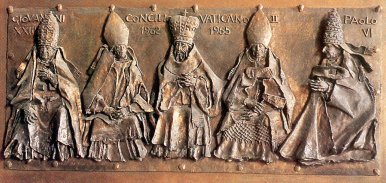
The Second Vatican Council reviewed what was happening in the Catholic Church and what was happening in the world. It was the twenty-first Ecumenical Council of the Catholic Church and the second to be held at St Peter's Basilica in the Vatican. It opened under Pope John XXIII in 1962 and closed under Pope Paul VI in 1965. The main aims of the Council were:
-        to examine the nature of the Church and the role of the bishop;
-        to renew the Church;
-        to seek unity among all Christians;
-        to start to relate to the modern world.
The documents that were produced led to changes in the Catholic Church, including the change from celebrating Mass in Latin to celebrating in English.


CCC 938 The Bishops, established by the Holy Spirit, succeed the apostles. They are "the visible source and foundation of unity in their own particular Churches" (LG 23).

In the catechism there are a lot of references to other church documents.  In the catechism these are identified by the initials of the first two or three Latin words, by which the document is known.  For example, LG - Lumen Gentium (Christ is the Light of the nations)
Vatican documents can be found on the Vatican website: Lumen Gentium


The Inspire display at the Cathedral has four sections and each one contains one of the four constitutions of the Vatican II Council.  

Friday, October 19, 2012

1 YOUCAT - Catechism for Young People

YOUCAT: Youth Catechism
Youcat is a catechism designed for young people.  Like the Compendium it is organised using a series of questions and includes references to the Catechism of the Catholic Church.  There are quotes from a wide range of people and examples from everyday life.  Youcat is supported by a website, Facegroup study groups, with videos, quizzes, materials.

Question of the Month
Click image to read other questions

Did you know, Youcat is organised in the same sections as the Catechism and Compendium? 
CCC 13 The plan of this catechism is inspired by the great tradition of catechisms which build catechesis on four pillars: the baptismal profession of faith (the Creed), the sacraments of faith, the life of faith (the Commandments), and the prayer of the believer (the Lord's Prayer).
Quiz Time Why not have a go at the YOUCAT QUIZ

Wednesday, October 17, 2012

1 Compendium of the Catechism


The Compendium has:
* the same four sections as the Catechism of
  the Catholic Church (CCC)

   1) “The Profession of Faith”,  lex credendi, 
   2) “The Celebration of the Christian
       Mystery”,
lex celebrandi 
   3) “Life in Christ”, lex vivendi
   4) “Christian Prayer”,  lex orandi
* a question and answer format and has
   references to the CCC

* sacred art -  which on the basis that a
  picture paints a 1000 words, is another way  
  we can learn about our faith. 

CCC 11 This catechism aims at presenting an organic synthesis of the essential and fundamental contents of Catholic doctrine, as regards both faith and morals, in the light of the Second Vatican Council and the whole of the Church's Tradition. Its principal sources are the Sacred Scriptures, the Fathers of the Church, the liturgy, and the Church's Magisterium. It is intended to serve "as a point of reference for the catechisms or compendia that are composed in the various countries".

Wednesday Words of Witness WWW
On the Cathedral Parish blog we have a new series starting for the Year of Faith. To find out more about WWW click here and to read more of our first entry by Sr Zela Procter click here.

Monday, October 15, 2012

1 Catechism of the Catholic Church

Our first object of faith is the Catechism of the Catholic Church. See our links page for electronic links to this book which contains all the teachings of the Catholic faith.
It was first suggested that a Catechism should be written at a Meeting of Bishops in 1985 and on 11th October 1992, Blessed Pope John Paul II gave the Catechism to the Church to be used as a tool to help Catholics live out their faith. Many Bishops worked together to write the Catechism which is used in the Catholic Church throughout the world. It has four sections which are referred to as the four pillars of the faith: 
  1. The Profession of Faith (the Creed), 
  2. The Sacraments of Faith, 
  3. The Life of Faith (the Commandments) and 
  4. Prayer in the Life of Faith (including the Lord's prayer). CCC13
When referencing sections of the Catechism of the Catholic Church the initials CCC are used, and then followed by a number which refers to a paragraph in the catechism.  

CCC 11 This catechism aims at presenting an organic synthesis of the essential and fundamental contents of Catholic doctrine, as regards both faith and morals, in the light of the Second Vatican Council and the whole of the Church's Tradition. Its principal sources are the Sacred Scriptures, the Fathers of the Church, the liturgy, and the Church's Magisterium. It is intended to serve:
 "as a point of reference for the catechisms or compendia that are composed in the various countries".

Sunday, October 14, 2012

Objects of Faith

Lancaster Cathedral Display INSPIRE
During the Year of Faith we will be exploring objects linked to our faith.  Some of the core objects of faith are already displayed at the back of the Cathedral in our display INSPIRE.  We will be looking at these more closely in the weeks ahead,
Each week we will introduce a new object and give links to the Catechism of the Catholic Church which helps explain what the Church teaches and believes.  For a list of the objects that will appear each week click the objects page.


When referencing sections of the Catechism of the Catholic Church the initials CCC are used, and then followed by a number which refers to a paragraph in the catechism.


Council of Jerusalem


Events
Curious about Vatican Council starts on Tuesday 16th October at 7.30pm 

St Walberge’s Chapel, Balmoral Road, Lancaster, next to the Cathedral, parking in the Pastoral Centre and Social Centre.

All Welcome

Thursday, October 11, 2012

Year of Faith begins

Today is the official start to the year of faith.  Like so many of the images and objects at Church, the logo for the year of faith has great symbolism. The boat is the sign of the Church.  The cross is the sign of love, it’s the sign of our faith. The sun which is behind the sails represents the Eucharist which is the centre of our lives of faith. 
The logo is composed of a square, bordered field on which a boat, symbolizing the Church, is represented as sailing on a graphically minimal representation of waves. The main mast of the boat is a cross from which sails are displayed in the form of dynamic signs which compose the trigram of Christ (IHS). The background to the sails is a sun which, associated with the trigram, refers also to the Eucharist. (Description from the official Year of Faith website)
How long is the Year of Faith?
This is not a trick question, and surprisingly the answer is not what you might expect.  In fact it is more than a year, 409 days, or 58 weeks and 3 days, or 9816 hours, 588,960 minutes, 35,337,600 seconds to be precise.  In recent weeks we've had a clock counting down to the start of the Year of Faith, see right for our new clock to count down the year of faith.

Day of prayer
Throughout the day At the Cathedral there is a day of prayer to which everyone is welcome to attend. 

For a full programme and details of the Angelus which we will say at 9.00am, noon, and 6.00pm click here.  

The day will end with compline (night prayer).  If you aren't able to come, you may want to join in using the two videos below to say night prayer.


Saturday, October 6, 2012

The Wall of Faith

The timeline for the Year of Faith continues to grow as details about Popes, Church Councils (special meetings of the Church which we will be writing about in future posts), and Cathedrals around the world, are added to the timeline.
This first image shows St Peter the first Pope, and an image from the stained glass windows in the Cathedral that show his life. The image is of the First Council in Jerusalem.  
We hope that during the year many who visit the Cathedral will have time to come and look at the timeline.
.   
The 400 shows what was happening 400 years after Jesus was born.  Just above each century there is a boat, which is the logo of the Year of Faith, more about this on Thursday when the Year begins.  Here we see a Map of Invasions of the Roman Empire and images of the 39th Pope, St Anastasius 1
The Cathedral parish website includes activities for children (and adults!), these include questions, crosswords, and things to find out.  Look out for this sign and a link to future challenges. Can you find out how many Pope's have there been since St Peter?


Remember all are welcome to join us for a day of prayer as we begin the Year of Faith. Thursday 11th October starting with the Angelus and Mass at 9.00am and ending with Compline (night prayer) at 9.00pm.  There will be exposition of the Blessed Sacrament throughout the day.

Monday, October 1, 2012

Sharing faith with children

Sharing our faith starts at an early age.  Parents are the first teachers of the faith, on Friday 20th September we showed catechists preparing for primary school visits. 
Claire and her daughter 


Throughout the August training, catechists were joined by our youngest trainee!

As the Catechism of the Catholic Church says:

CCC 2226 Education in the faith by the parents should begin in the child's earliest years. ...

CCC 2252 Parents have the first responsibility for the education of their children in the faith, prayer, and all the virtues. They have the duty to provide as far as possible for the physical and spiritual needs of their children.

When referencing sections of the Catechism of the Catholic Church the initials CCC are used, and then followed by a number which refers to a paragraph in the catechism.  There will be more about the Catechism of the Catholic Church in October.

For ideas of things to do with children see Cathedral blog and consider following up some of the opportunities for adults to deepen their knowledge of the faith.  See adult page for some plans for the year ahead.  

If you have an idea of how you share faith with children that you'd be willing to share, please use our contact us page to get in touch.