Friday, November 22, 2013

58 Following Christ the King

On Sunday, we celebrate the Feast of Christ the King, this is the last day of the Year of Faith.  We are reminded in the Catechism of the Catholic Church that: 
Dove a symbol of the Holy Spirit
flying above a Baptismal font
On entrance to Baptistry Lancaster Cathedral

CCC 783 Jesus Christ is the one whom the Father anointed with the Holy Spirit and established as priest, prophet, and king. The whole People of God participates in these three offices of Christ and bears the responsibilities for mission and service that flow from them.

CCC 1546 Christ, high priest and unique mediator, has made of the Church "a kingdom, priests for his God and Father." The whole community of believers is, as such, priestly. The faithful exercise their baptismal priesthood through their participation, each according to his own vocation, in Christ's mission as priest, prophet, and king. Through the sacraments of Baptism and Confirmation the faithful are "consecrated to be . . . a holy priesthood."

When we are baptised we are anointed with Chrism, which is used again at Confirmation when the gifts of the Holy Spirit are confirmed.  As this year of faith comes to an end we are still called to consider how we will respond to God's call to us to be priest, prophet and king.  

 What will you do?

Thursday, November 21, 2013

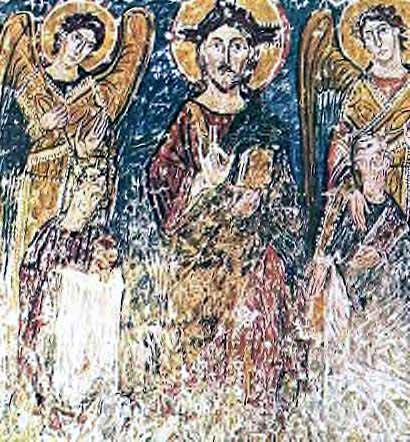
58 Icon of Christ the King

Our Year of Faith closes on the feast of Christ the Universal King. This feast day is celebrated on the last Sunday of the liturgical year and the following Sunday sees the beginning of Advent. Christ the King is a title for Jesus based on several passages of scripture. Pope Benedict XVI has said that Christ's kingship is not based on 'human power' but on loving and serving others. Christ is our King and we are called to enthrone him in our lives by loving and serving others as he did. 

CCC 1159 The sacred image, the liturgical icon, principally represents Christ. It cannot represent the invisible and incomprehensible God, but the incarnation of the Son of God has ushered in a new "economy" of images:

Previously God, who has neither a body nor a face, absolutely could not be represented by an image. But now that he has made himself visible in the flesh and has lived with men, I can make an image of what I have seen of God . . . and contemplate the glory of the Lord, his face unveiled. 
Christ the King:
Lancaster Cathedral Te Deum Window

Monday, November 18, 2013

57 Particular and Universal Judgement

Charles Filger: The Last Judgement (1890s)
The Catechism explains that when we die there are two types of judgement.  Particular judgement which happens when we die and is individual, and universal judgement at the end of time, when Christ will come again. The judgement is not ours to make, it is important for us to remember that we are not called to judge, rather at this time of judgement we will as it says in St Paul's letter to the Corinthians:
“At present we see indistinctly, as in a mirror, but then face to face. At present I know partially; then I shall know fully, as I am fully known” (1 Corinthians 13:12)
Particular Judgement: 9th Century Icon
CCC 1021 Death puts an end to human life as the time open to either accepting or rejecting the divine grace manifested in Christ. The New Testament speaks of judgement primarily in its aspect of the final encounter with Christ in his second coming, but also repeatedly affirms that each will be rewarded immediately after death in accordance with his works and faith. The parable of the poor man Lazarus and the words of Christ on the cross to the good thief, as well as other New Testament texts speak of a final destiny of the soul--a destiny which can be different for some and for others.
Apostles' Creed:  I believe ...
The spirituality discussions based on the Apostles Creed that have been taking place at St Thomas More looked at the articles of faith which are linked to statements I believe in resurrection of the dead and life everlasting.  The group used St Paul's letter to the 1 Corinthians Chapter 15  as a basis for lectio divina, sacred reading and followed this by sharing their images of heaven.
Images from focal area for spirituality session

Saturday, November 16, 2013

57 The Last Judgement

Michelangelo's 'The Last Judgemenf'
For larger image 
The Last Judgement is referred to in the Bible and particularly in the Gospels. It refers to the belief that one day Christ will come in His glory with all the angels and in his presence, every person's relationship with God will be judged. 

CCC 635 Christ went down into the depths of death so that "the dead will hear the voice of the Son of God, and those who hear will live." Jesus, "the Author of life", by dying destroyed "him who has the power of death, that is, the devil, and [delivered] all those who through fear of death were subject to lifelong bondage." Henceforth the risen Christ holds "the keys of Death and Hades", so that "at the name of Jesus every knee should bow, in heaven and on earth and under the earth."
Today a great silence reigns on earth, a great silence and a great stillness. A great silence because the King is asleep. The earth trembled and is still because God has fallen asleep in the flesh and he has raised up all who have slept ever since the world began. . . He has gone to search for Adam, our first father, as for a lost sheep. Greatly desiring to visit those who live in darkness and in the shadow of death, he has gone to free from sorrow Adam in his bonds and Eve, captive with him - He who is both their God and the son of Eve. . . "I am your God, who for your sake have become your son. . . I order  you, O sleeper, to awake. I did not create you to be a prisoner in hell. Rise from the dead, for I am the life of the dead." 


For further information about the history of the painting and explanation of what Pope Paul III who asked Michelangelo to paint this fresco (wall painting) including a video with an explanation of  details of the painting see Smarthistory 


Why not come and have a look at what else Paul III did, and the Popes who came before and after him - by coming and having a look at the Year of Faith timeline at Lancaster Cathedral - Wall of Faith


Wednesday, November 13, 2013

56 Mission Box: Missio Children's Mission

Screen capture of Mission Together Website 


Children helping children 

is the motto of Mission Together the children's Mission charity.

May all children
In the world
Share love
Share friendship
In the peace
Of God’s love
Now and forever

Sunday, November 10, 2013

56 Mission Box

Mission Boxes
The Church is called to be missionary, which means, to proclaim the Gospel to those who do not believe in Christ. Every member of the Church should be united in this task. We are called to share the Gospel with those in our local community through what we say and how we behave. Our example may speak louder than words so that others see our way of life as followers of Jesus and want to find out more. At other times, we may be called to speak out about Jesus' teachings and example or the teachings of the Church. Some people dedicate their lives to missionary work in other countries where they bring the teachings of Jesus to those who haven't heard them through their love and care for others, their prayer life and by sharing the Gospels with them. The Church raises money to support missionaries in their work. One way to do this is through the APF (Association for the Propagation of the Faith) Red Mission Box. The boxes are kept in Catholic homes and money is collected in them. The money is sent to the APF and distributed to help bring God's love and hope to the poorest and most in need people throughout the world.

CCC 854 By her very mission, "the Church . . . travels the same journey as all humanity and shares the same earthly lot with the world: she is to be a leaven and, as it were, the soul of human society in its renewal by Christ and transformation into the family of God." 
...Missionary endeavor requires patience. It begins with the proclamation of the Gospel to peoples and groups who do not yet believe in Christ, continues with the establishment of Christian communities that are "a sign of God's presence in the world," and leads to the foundation of local churches. It must involve a process of inculturation if the Gospel is to take flesh in each people's culture. There will be times of defeat. "With regard to individuals, groups, and peoples it is only by degrees that [the Church] touches and penetrates them and so receives them into a fullness which is Catholic."

Wednesday, November 6, 2013

55 Book of the Dead

Book of the Dead moved to the altar during November
CCC 1032 This teaching is also based on the practice of prayer for the dead, already mentioned in Sacred Scripture: "Therefore [Judas Maccabeus] made atonement for the dead, that they might be delivered from their sin." From the beginning the Church has honoured the memory of the dead and offered prayers in suffrage for them, above all the Eucharistic sacrifice, so that, thus purified, they may attain the beatific vision of God. The Church also commends alms giving, indulgences, and works of penance undertaken on behalf of the dead:
Let us help and commemorate them. If Job's sons were purified by their father's sacrifice, why would we doubt that our offerings for the dead bring them some consolation? Let us not hesitate to help those who have died and to offer our prayers for them.

Saturday, November 2, 2013

55 Book of the Dead

1st November is 'All Saints' Day' when the Church remembers those who have died and are now in eternal life with God. 
2nd November is 'All Souls' Day' when the Church throughout the world prays for those who have died and still await eternal life with God. The whole of November is devoted to prayer for the dead; we pray for those who have died, just as we hope that the saints pray for us. The Book of the Dead stands in a prominent place during November and in it is written the names of those who have died in a Parish.
Eternal rest grant unto them, O Lord,
and let perpetual light shine upon them.
May they rest in peace. Amen. 

Altar Server lighting candles next to Book of the Dead


Saturday, October 26, 2013

54 Statue of Our Lady

Statute of Mary the Mother of God
A statue of Our Lady is found in all Catholic Churches and this is because of the special devotion with which the Church honours Mary. From ancient times, Mary has been called 'Mother of God' and she is the perfect role model for us all. She said 'yes' to God and gave her life completely to carrying out God's will. Mary knew joy and she also knew suffering. 
We call her Mother of the Church and our Mother and we can turn to her with our own joys and sorrows. We can pray with Mary and we can pray to her. We ask her to intercede for us which means that we ask her to ask Jesus for our desires, believing that Jesus listens to his Mother who prays for us.


CCC 971 "All generations will call me blessed": "The Church's devotion to the Blessed Virgin is intrinsic to Christian worship." The Church rightly honours "the Blessed Virgin with special devotion. From the most ancient times the Blessed Virgin has been honoured with the title of 'Mother of God,' to whose protection the faithful fly in all their dangers and needs. . . . This very special devotion . . . differs essentially from the adoration which is given to the incarnate Word and equally to the Father and the Holy Spirit, and greatly fosters this adoration." The liturgical feasts dedicated to the Mother of God and Marian prayer, such as the rosary, an "epitome of the whole Gospel," express this devotion to the Virgin Mary.
Mother and child -
entry in original Cathedral Blog
We welcome photographs of statues of Mary or drawings - please get in touch using the contact page.

Saturday, October 19, 2013

53 Memorare

The Memorare is a prayer that reminds us that Mary is our protector and one to whom we can ask for help. It is thought that St Bernard of Clairvaux may have written the prayer in the 12th century. In the 17th century, a priest called Father Claude Bernard used the prayer often in his work with the sick and those in prison and he believed that Mary truly helped him in his work. The Church teaches that Mary is the Mother of the Church and our mother as well “in the order of grace” (which means spiritually) as we read in the Catechism of the Catholic Church (CCC 969).

Remember, O most gracious Virgin Mary,
that never was it known that anyone who fled to thy protection,
implored thy help, or sought thy intercession was left unaided.
Inspired with this confidence,
I fly to thee, O Virgin of virgins, my Mother;
to thee do I come;
before thee I stand, sinful and sorrowful.
O Mother of the Word Incarnate,
despise not my petitions,
but in thy mercy hear and answer me. Amen
Link to he above video which is a modern musical version of the Memorare  
CCC 2675 Beginning with Mary's unique cooperation with the working of the Holy Spirit, the Churches developed their prayer to the holy Mother of God, centering it on the person of Christ manifested in his mysteries. In countless hymns and antiphons expressing this prayer, two movements usually alternate with one another: the first "magnifies" the Lord for the "great things" he did for his lowly servant and through her for all human beings the second entrusts the supplications and praises of the children of God to the Mother of Jesus, because she now knows the humanity which, in her, the Son of God espoused.
For further information about St Bernard of Clairvaux 


St Bernard of Clairvaux 1090-1153

Tuesday, October 15, 2013

52 Rosary Mary shows the way

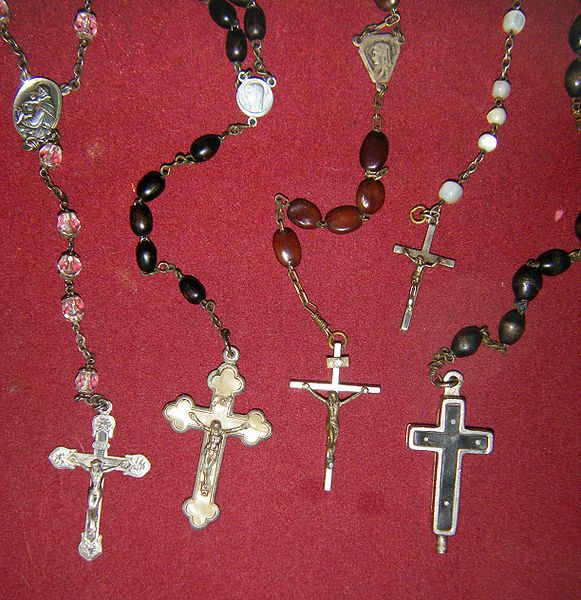
Assorted Rosary Beads
CCC 2674 Mary gave her consent in faith at the Annunciation and maintained it without hesitation at the foot of the Cross. Ever since, her motherhood has extended to the brothers and sisters of her Son "who still journey on earth surrounded by dangers and difficulties." Jesus, the only mediator, is the way of our prayer; Mary, his mother and ours, is wholly transparent to him: she "shows the way" (hodigitria), and is herself "the Sign" of the way, according to the traditional iconography of East and West.
Praying the Rosary on line
This is a site where you can join others in praying the rosary


Is the rosary said at your Church?  This is a form of prayer that can be said alone or in small groups.  Some parishes have a set time in the week, many pray the rosary on the first Saturday.  For details of the first Saturday rosary at the Cathedral in Lancaster and the Lancaster Cathedral Diary.   

Friday, October 11, 2013

52 Rosary

Three of the Mysteries - Joyful, Sorrowful and Glorious
October is the month of the Rosary. The Rosary is a way of praying that honours Mary and asks for her help or intercession. Special beads, known as 'Rosary beads' are used and these help us to count the series of prayers that make up the Rosary. The Rosary is split into four groups called
The Joyful Mysteries,
The Mysteries of Light, or Luminous Mysteries
The Sorrowful Mysteries and
The Glorious Mysteries. 


These in turn are each divided into five times in the life of Jesus and Mary that we reflect on when we pray the Rosary. 


 Joyful Mysteries are:
The Annunciation
The Visitation
The Nativity
The Presentation of Jesus in the Temple
The Finding of the Child Jesus in the Temple

Each time we reflect on one of these times, we pray a decade of the Rosary. 
A decade means a group of ten prayers and it starts with one 'Our Father', then ten 'Hail Marys' and ends with a 'Glory be to the Father'. The Rosary beads help us to count the ten Hail Marys so that as our fingers touch the beads and we pray the words we can imagine the scene we are reflecting on and open our hearts to Jesus.

Luminous Mysteries are:

The Baptism in the Jordan (Top left)

The Wedding at Cana (Marriage at Cana) (Top right)

The Proclamation of the Kingdom of God (Christian mission) (Bottom Left)
The Transfiguration (Bottom right)
The Institution of the Eucharist (Last Supper) (Centre)

Prayer Card of Luminous Mysteries
For further prayer cards see The Way of Beauty Blog


Tuesday, October 8, 2013

51 Religious Sisters in Lancaster Diocese


During the Vocations Novena in 2013 there were a number of posts in the Cathedral and St Thomas More parish blog.  If you would like to know more about the following 


Ursuline Sisters - who are based at St Thomas More.  To read more see also Sr Zela Proctors own blog. 
Ursuline-religious life Blog
Our Lady of Hyning  - and to read more of the Gospel and Grub prayer group being led by Sr Maria from Hyning.   
Advert for Gospel and Grub Prayer Group
For further details 
Sisters of Nazareth - one of the earliest religious groups in Lancaster, to read more about the early days of the Sisters of Nazareth.


For further information about vocations and discernment days or weekends organised by religious sisters in the Diocese see their websites links available in the posts mentioned above and the Diocesan Vocations website.  


Poster Please pray for priests and religious

Friday, October 4, 2013

51 Religious Life

Screen capture of UK Religious Life list of religious orders 
Religious life is an invitation to live life to its fullest with total commitment to God, as a member of a religious community. A person who is called to religious life becomes a nun (female) or a monk (male). They take three vows: poverty, obedience and celibacy. This means that they live simply, they are obedient to the rule of their order and the will of God and they do not marry. In this way, they are free to give themselves completely in service of the Church and to do this wherever they are called to be. For some, this may mean travelling to other parts of the world to serve and share the Gospel with those in need. For others, it may be serving in parishes, hospitals, schools and communities in this country. Some religious sisters (nuns) and brothers (monks) enter enclosed orders which means they spend most of their time just with their religious community and they serve the Church in prayer.

Screenshot from UK Religious Life website

CCC 931 Already dedicated to him through Baptism, the person who surrenders himself to the God he loves above all else thereby consecrates himself more intimately to God's service and to the good of the Church. By this state of life consecrated to God, the Church manifests Christ and shows us how the Holy Spirit acts so wonderfully in her. And so the first mission of those who profess the evangelical counsels is to live out their consecration. Moreover, "since members of institutes of consecrated life dedicate themselves through their consecration to the service of the Church they are obliged in a special manner to engage in missionary work, in accord with the character of the institute."


During the novena for vocations the Cathedral Parish blog had a number of posts about religious sisters who have had a connection with the Lancaster Diocese and the Cathedral and St Thomas More's parish in particular.  In the next few days we'll include some links to religious sisters in the Lancaster Diocese.


Friday, September 27, 2013

Education Mass - Lancaster University Chaplaincy

Bishop Michael Campbell and diocesan clergy
Education Mass 20113
Thursday 26th September, teachers, governors, catechists and a number of priests from around the diocese joined Bishop Michael Campbell for a final celebration of the Year of Faith.  It was nearly a year ago when the diocese gathered in Lancaster Cathedral to mark the start of the Year of Faith.  


Young people from Our Lady's Catholic School Preston, conducted by Mr Robinson, Head of Music, led the congregation in music.  Following his homily, the congregation renewed their Baptismal Promises and the Bishop blessed those present with Holy Water.  


Bishop Michael Campbell sprinkling
congregation with Holy Water
After Mass, Bishop Michael Campbell returned to present certificates and commission educators throughout the diocese including those who were starting their teaching career, retiring or had gained promotion.  He also gave out Catholic Certificate in Religious Studies (CCRS) to individual teachers and catechists including one of the Cathedral's Confirmation Catechists.  As part of the year of faith the Diocese has supported individuals to undertake a module on the Catechism - so with 57 days left to the end of the Year of Faith you may want to find out more.   

Free ONLINE CCRS COURSE CCRS Module on Catechism Enabling any parishioners who are interested to be able to access and follow the on-line Catechism of the Catholic Church module of the CCRS.


Tuesday, September 24, 2013

50 Code of Canon Law

Code of Canon Law 
Every organisation requires its own laws and customs to maintain order. The Code of Canon Law is the ordered set of laws which governs the Catholic Church. It was first issued in 1917 and revised in 1983.  The need to revise the 1917 Code was identified by Pope John XXIII, but it was not actually revised until 1983 by John Paul II.  

There are 1,572 Canons or laws. These are divided into 7 Books: 
  • BOOK I. - GENERAL NORMS 
  • BOOK II. THE PEOPLE OF GOD - Christian Faithful, Hierarchy of the Church, Consecrated life
  • BOOK III. THE TEACHING FUNCTION OF THE CHURCH - Preaching, Catechesis and Catholic Education
  • BOOK IV. FUNCTION OF THE CHURCH - Sacraments and other Divine Acts
  • BOOK V. THE TEMPORAL GOODS OF THE CHURCH 
  • BOOK VI. SANCTIONS IN THE CHURCH 
  • BOOK VII PROCESSES
To read more see online version of Canon Law

Website of Canon Law
There are a number of differences between the two versions.  For instance, the 1983 version deals with the laity first, whereas the 1917 Code dealt with them at the end.  
Can.  1752 In cases of transfer the prescripts of can. 1747 are to be applied, canonical equity is to be observed, and the salvation of souls, which must always be the supreme law in the Church, is to be kept before one’s eyes.
For some other facts about the Code of Cannon Law 

Sunday, September 15, 2013

49 CTS leaflets

Catholic Truth Society CTS  leaflets 
CTS stands for 'Catholic Truth Society' and the key aim of the CTS is to help people to understand and practise the Catholic faith. The CTS publishes many leaflets which explain different aspects of Catholic faith. They are designed to help Catholics to understand more about the faith they practise – we call this catechesis.


CCC 4 Quite early on, the name catechesis was given to the totality of the Church's efforts to make disciples, to help men believe that Jesus is the Son of God so that believing they might have life in his name, and to educate and instruct them in this life, thus building up the body of Christ.7

Thursday, September 12, 2013

48 Mass Cards

A Mass Card is a card that is given to someone to let them know that they, or a deceased loved-one, will be remembered and prayed for in the intentions at a Mass. Every Mass has an intention. This means that everyone who is celebrating the Mass is praying for the person for whom the Mass is being offered. Of course, everyone may also come to Mass with their own personal intentions too. 


Cards from Cathedral Bookshop
Open after Sunday 10.30 Mass 
CCC 1325 "The Eucharist is the efficacious sign and sublime cause of that communion in the divine life and that unity of the People of God by which the Church is kept in being. It is the culmination both of God's action sanctifying the world in Christ and of the worship men offer to Christ and through him to the Father in the Holy Spirit."


Mass Card 


Details of Mass intentions are sometimes announced by the priest or appear in a parish newsletter this reminds other members of the community who the Mass intention.


Monday, September 9, 2013

47 Incense - Liturgy of the Word

Thurible used at 
Lancaster Cathedral

Incense is used during Mass and as the smoke from the burning incense rises, it symbolises our prayers rising to God. The incense is carried in a container called a boat. It is blessed and then spooned into the thurible which is used to hold incense as it burns. The thurible is held on a chain which is swung by the priest, deacon or server towards what or who is being incensed. This could be the altar, the Gospel, the bread and wine offered for the Eucharist, the consecrated Eucharist, the priest or bishop celebrating Mass, the congregation, the Paschal candle, the crucifix or the Blessed Sacrament during Benediction.

CCC 1154 The liturgy of the Word is an integral part of sacramental celebrations. To nourish the faith of believers, the signs which accompany the Word of God should be emphasized: the book of the Word (a lectionary or a book of the Gospels), its veneration (procession, incense, candles), the place of its proclamation (lectern or ambo), its audible and intelligible reading, the minister's homily which extends its proclamation, and the responses of the assembly (acclamations, meditation psalms, litanies, and profession of faith).


The icons  have been travelling around the secondary schools in the Diocese 
Bishop Michael Campbell incensing
Year of Faith Icons 
at Education Mass 2012

Saturday, September 7, 2013

47 Incense Thurifer

Thurifer leading procession
Altar Servers Mass 2008
 The Thurifer is the server who carries the thurible and will incense the priest and people.  Below the thurifer is seen swinging the thurible during the Gospel after the Deacon has incensed the Gospel. 

Thurifer standing behind Deacon
during 150th Anniversary Mass October 2010
CCC 1154 The liturgy of the Word is an integral part of sacramental celebrations. To nourish the faith of believers, the signs which accompany the Word of God should be emphasized: the book of the Word (a lectionary or a book of the Gospels), its veneration (procession, incense, candles), the place of its proclamation (lectern or ambo), its audible and intelligible reading, the minister's homily which extends its proclamation, and the responses of the assembly (acclamations, meditation psalms, litanies, and profession of faith).
Giant Thurible
One of the largest thurible needs a team of servers to swing it to incense the altar.  See video below of the thurible in the Cathedral of Santiago de Compostela or open video in separate page

Wednesday, September 4, 2013

47 Incense - Thurible

Thurible
Incense is used during Mass and as the smoke from the burning incense rises, it symbolises our prayers rising to God. The incense is carried in a container called a boat. It is blessed and then spooned into the thurible which is used to hold incense as it burns. The thurible is held on a chain which is swung by the priest, deacon or server towards what or who is being incensed. This could be the altar, the Gospel, the bread and wine offered for the Eucharist, the consecrated Eucharist, the priest or bishop celebrating Mass, the congregation, the Paschal candle, the crucifix or the Blessed Sacrament during Benediction.

This is one of the thuribles used at the Cathedral.

Bishop Michael Campbell incensing
Year of Faith Icons 
at Education Mass 2012
The icons  have been travelling around the secondary
schools in the Diocese 


Sunday, September 1, 2013

46 Book of the Gospels

The Book of the Gospels contains the Gospels of Matthew, Mark, Luke and John and is used during Mass when the priest or deacon proclaims the Gospel. There may be a procession with the Book ofGospels from the altar to the ambo (the place of reading) and incense may be used to honour the Gospel. This reminds us of the importance of listening to God's Word, spoken to us through the Gospel. As we listen with open hearts, we learn more about Jesus, his teachings and example. Jesus shows us the way to God our Father and this is why it is so important to listen to the Gospel and reflect on what God may be saying to us.
CCC 125 The Gospels are the heart of all the Scriptures "because they are our principal source for the life and teaching of the Incarnate Word, our Saviour".
The Book of Gospels held over Bishop Michael's head during his ordination
This symbolises the centrality of the Gospel in the life of a bishop. A bishop's calling
as a successor of the Apostles is rooted in the Gospel; his duty is to preach the Gospel
faithfully and fearlessly; his own life of faith must always be founded on what God
 has revealed to us in Christ.  To read more of ordination

Thursday, August 29, 2013

45 Lectionary - Ambo

The Ambo is where the Liturgy of the Word is proclaimed.  At the Cathedral the link between the breaking open of the Word at the Ambo, and breaking of the bread at the altar is highlighted by the same design and stone work of each object.


Ambo at Lancaster Cathedral -
decorated during the Flower Festival 2009 click to see other images 
CCC 102 Through all the words of Sacred Scripture, God speaks only one single Word, his one Utterance in whom he expresses himself completely:
You recall that one and the same Word of God extends throughout Scripture, that it is one and the same Utterance that resounds in the mouths of all the sacred writers, since he who was in the beginning God with God has no need of separate syllables; for he is not subject to time.
CCC 103 For this reason, the Church has always venerated the Scriptures as she venerates the Lord's Body. She never ceases to present to the faithful the bread of life, taken from the one table of God's Word and Christ's Body.

The catechism has plenty of references to Church Documents and Scripture, here you can see the link with Dei Verbum one of the Vatican 2 Constitutions.   

Dei Verbum (DV)
CHAPTER VI: SACRED SCRIPTURE IN THE LIFE OF THE CHURCH
DV 21 The Church has always venerated the divine Scriptures just as she venerates the body of the Lord, since, especially in the sacred liturgy, she unceasingly receives and offers to the faithful the bread of life from the table both of God's word and of Christ's body. She has always maintained them, and continues to do so, together with sacred tradition, as the supreme rule of faith, since, as inspired by God and committed once and for all to writing, they impart the word of God Himself without change, and make the voice of the Holy Spirit resound in the words of the prophets and Apostles. Therefore, like the Christian religion itself, all the preaching of the Church must be nourished and regulated by Sacred Scripture. For in the sacred books, the Father who is in heaven meets His children with great love and speaks with them; and the force and power in the word of God is so great that it stands as the support and energy of the Church, the strength of faith for her sons, the food of the soul, the pure and everlasting source of spiritual life. Consequently these words are perfectly applicable to Sacred Scripture: "For the word of God is living and active" (Heb. 4:12) and "it has power to build you up and give you your heritage among all those who are sanctified" (Acts 20:32; see 1 Thess. 2:13).
66 Cf. DV 21.
67 1 Thes 2:13; cf. DV 24.
68 DV 21.


Tuesday, August 27, 2013

45 Lectionary

The Lectionary contains all the readings from the Bible that are used at Mass. It is organised so that for each day there is a first reading (usually Old  Testament), Psalm, second reading (on Sundays and Feasts days only – New Testament) and Gospel reading.  
The Sunday readings are organised into a 3-year cycle, called A, B, C and each yearly cycle begins on the first Sunday of Advent.
Year A: Gospel of Matthew 
(last time November 2010 through 2011, next starts November 2013)
Year B: Gospel of Mark 
(last time December 2011 through  2012, next starts November 2014)
Year C: Gospel of Luke 
(November 2012 through November 2013)

The Gospel of John is read throughout Easter, and is used for other liturgical seasons including Advent, Christmas, and Lent where appropriate. The Liturgy of the Word is the part of the Mass where we listen to readings from the Lectionary.  We believe that we are listening to God's Word and that God speaks to us through the readings. The priest's homily, which is given after the Gospel has been proclaimed, helps us to understand the readings and what they mean for us today.


Image of the four evangelists -
Can you see the symbolic animal?
CCC 104 In Sacred Scripture, the Church constantly finds her nourishment and her strength, for she welcomes it not as a human word, "but as what it really is, the word of God". "In the sacred books, the Father who is in heaven comes lovingly to meet his children, and talks with them."